
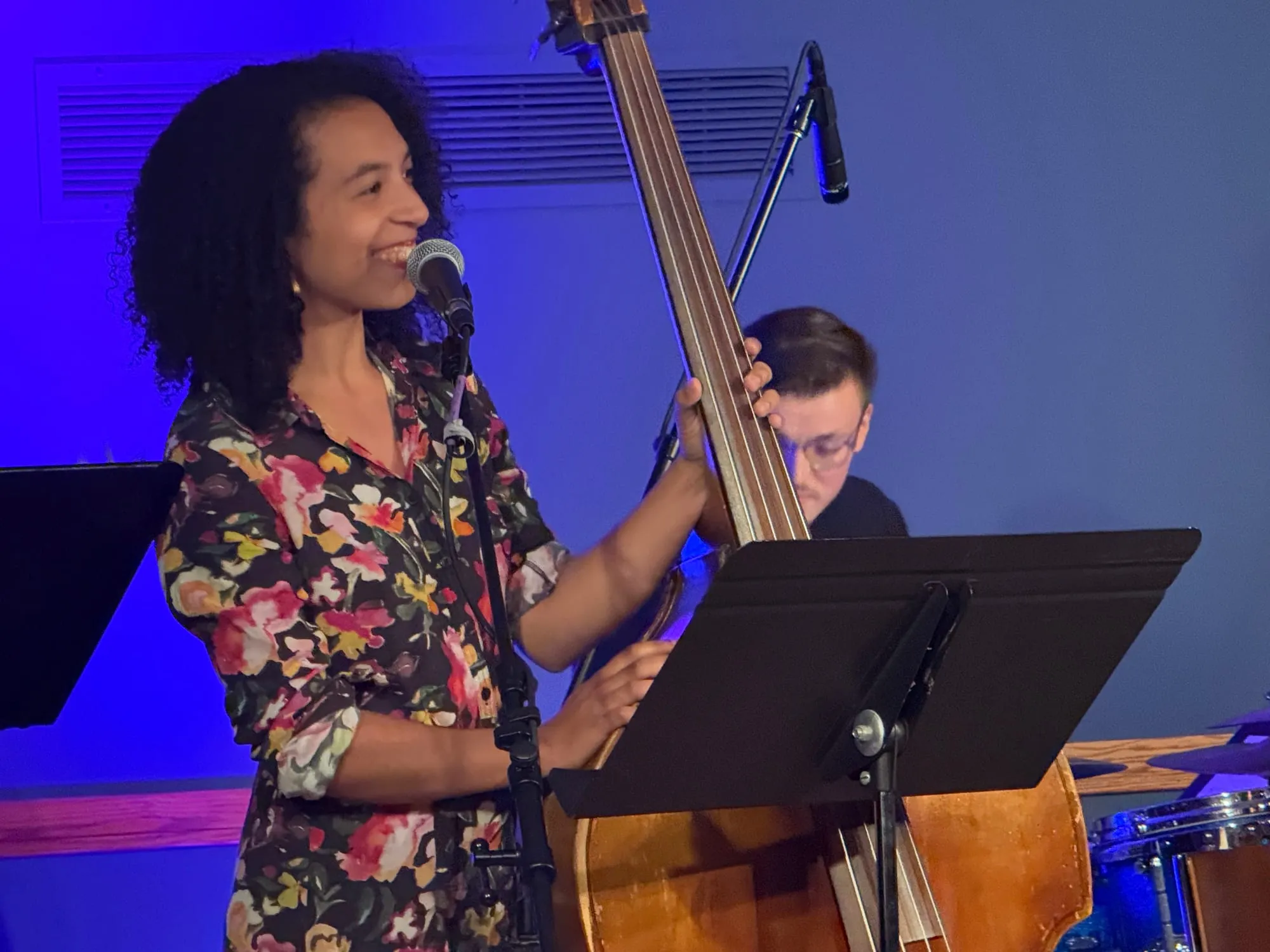
In the midst of the Head of the Charles, I decided to take a break from the Charles River and instead head to the Charles Hotel to arrive at, not a regatta, but the Regattabar, and to watch a dynamic team of musicians. On October 18th, the Regattabar hosted Devon Gates and Friends, a septet performing an array of covers along with Devon’s original music.
I was fortunate to meet Devon before attending Harvard. Devon had graduated in 2023 and completed a master’s at Berklee the following year as part of the Harvard-Berklee Dual Degree (now “Joint Studies”) Program. Seeing her perform in Cambridge would be my first time seeing her with a band, and it felt like a meaningful return to the start.
I arrived at the Regattabar fairly early, only to find the venue already close to full, with guests having arrived ahead of time to chat and order food in the restaurant-style setup. Before the concert, I had the chance to speak with two of these guests, who were also friends and collaborators of Devon’s, Fall Raye, and Simon Montalvo—their interview is included below.
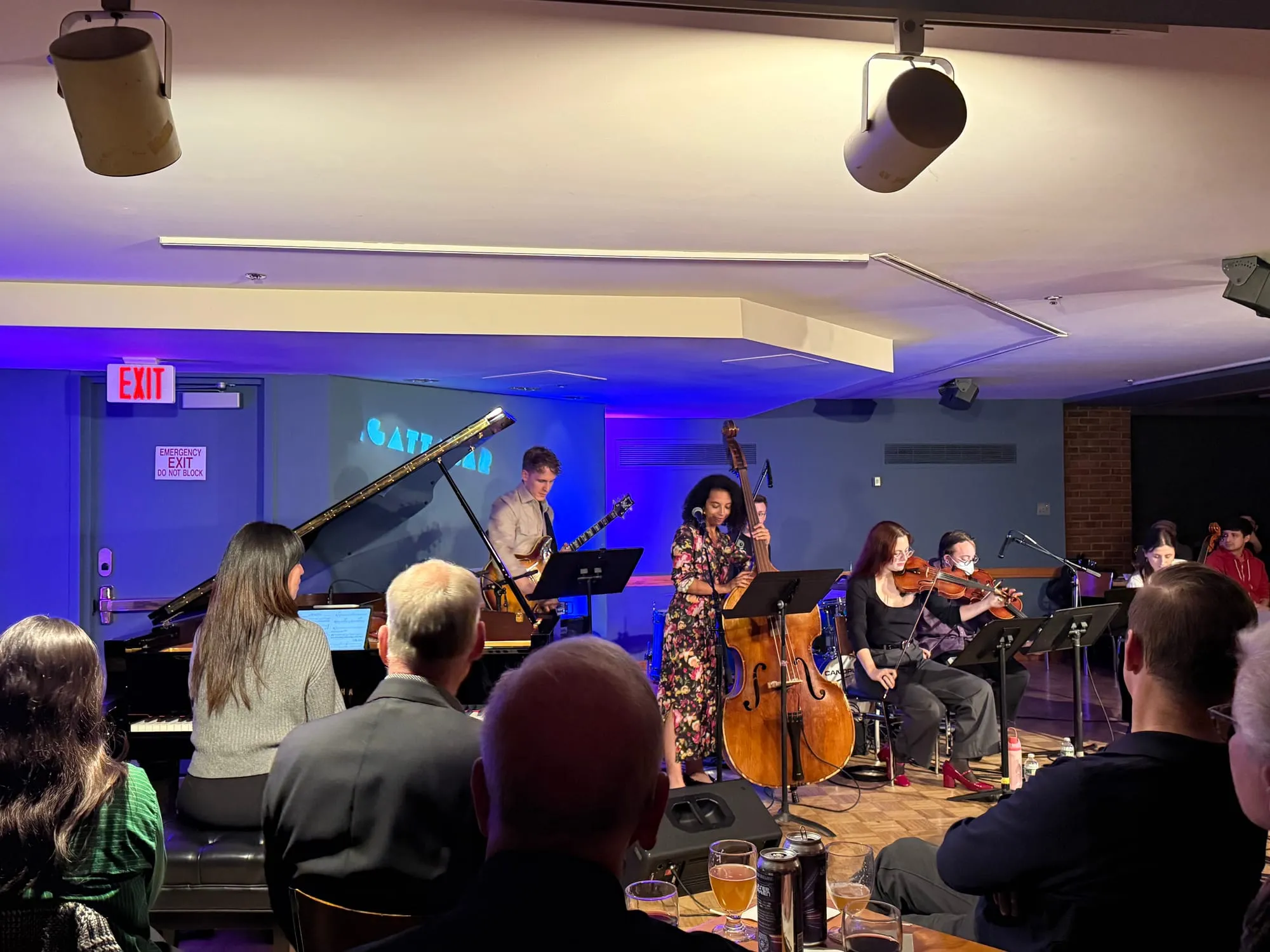
The band, featuring Yujin Han on piano, Matt Greenwood on guitar, Connor Sturge on drums, Angela Varo Moreno on violin, Phillip Rawlinson on viola, Queralt Giralt on cello, and Devon herself, entered to warm applause and cheers. However, a focused silence quickly fell at the first note of Jim Croce’s “Time in a Bottle,” a song that I felt was emblematic of the concert itself, as the time really did seem to pause. The band moved through a constant series of rises and falls, seemingly always pushing forward, yet still seamlessly on top of the changes, non-verbally communicating through each shift. Devon’s voice floated above the lush instruments along with a select violin or viola, her bass simultaneously holding everything down. Ultimately, in the intimate setting of the Regattabar, we were absorbed in the trance with the band. And accordingly, audience members were invited to join the band for the post-concert jam session!
I interviewed Devon to discuss the performance, how Harvard influenced her, and her plans into the future.
Laurel: How did you choose the songs for your set, aside from the ones you wrote?
Devon: So a lot of these songs I've been playing on and off for the past few years, workshopping and tweaking… like the song “Dividing Day,” which is from a musical that came out in the early 2000s… I rearranged it and put it in seven, and it sounds completely different. I've been playing that for the past few years in different formats, like quartet, and sometimes I'll just do quintet with two strings. I just really feel like it does well in that large group format with a seven-piece band, a septet. The set is a mixture of songs that I know work well in that format that I have charts for, and then, from looking at that list, songs that I think might fit well. Joni Mitchell’s “Taming the Tiger” is a newer arrangement that I've been trying out, and Jim Croce’s “Time in a Bottle”—that was maybe the first performance of that song as well.
L: I loved that one, because I always knew the 70s version of that song. Did you just know the song from the past and just think, Oh, this would be a really cool jazz arrangement or…?
D: Yeah, it can be so random sometimes. I grew up singing that song in elementary school choir. I randomly thought of it recently, and then I was toying around with it on the piano, thinking about arranging it, and I just figured it out. I think sometimes I'm trying to write a piece, but then I get distracted by things I want to arrange that already exist, and I sort of can't write something new until I see that through.
L: That's a really interesting process. And so much of the music that I like, I found through middle school and elementary school teachers. They can have such a big influence! I was also wondering, how did you meet everyone in your band?
D: That band is almost 100% people that I went to Berklee with. There's the violist Phillip, who went to NEC… But, same thing! So it's all folks that I ended up meeting in ensembles or in the Global Jazz Institute or the Institute of Jazz and Gender Justice that I ended up vibing with. Connor, the drummer, I've played this music with several times over the past few years, and Yujin, the pianist. Then, for some people like Matt, the guitarist, and Phillip, that was their first time playing this format. So it's definitely a mix of people who have been playing these songs since I wrote or first arranged them and people who are just kind of hopping along for the ride. Which is a fun mixture.
L: Totally. When you mentioned that you knew the drummer, I thought, “That makes sense,” because he was so into it! It’s also encouraging to hear that your band formed in the Berklee-Harvard universe.
D: Yeah, it's way more fun the more that you get to play the same music with the same people because you get into it more and really explore.
L: I also saw that you recently went to England again. How was that?
D: I went back in November to play at the London Jazz Festival, which was awesome, and a huge full-circle moment because the first time I played at the Jazz Festival was when I was studying abroad my last semester of undergrad in fall ‘23, and I did it through the Royal Academy of Music. And it was so much fun. And then, through people I met there and kept in touch with, the opportunity came up to do it again the next year, which I wasn't able to make happen because I was at Berklee in grad school. But then I was able to do it the year after, which was really special, with a lot of the same people who were studying abroad at the Royal Academy of Music two years ago. So it was really special to get to see people that I hadn't seen in a while and play with people that I went to school with who have now graduated. And I got to spend a lot of time going to my friends’ gigs.
L: That's so nice. Is the jazz scene there different from New York?
D: Yeah, totally. It's similar to New York in that there's just as much variety and diversity of jazz and any kind of music there, because it's also a huge city with lots of different pockets. North London versus South London versus East London… So that's also a lot of fun, getting to kind of traverse the different mini-scenes. But also, the names that people think of when they think of their favorite musicians on the scene are different there.
L: Really interesting.
D: Yeah, it's interesting. Because I get introduced to people that I might never have otherwise been introduced to.
L: Absolutely! I also wanted to ask, how did you choose to perform at the Regattabar? I know that you've done it in the past, too, but how did that start? And did you reach out to them?
D: Regattabar actually reached out to me. I played there for the first time in February 2024, which was really big for me. It was part of this series they were doing called the New Artist Spotlight, where they were choosing local artists in the Boston area to bring a band. And I’m very grateful to Jeremy Cohen, who was booking at the time, because I hadn't gotten that many bandleading opportunities. I had just gotten back from London before, so it was really a great opportunity to synthesize.
L: That's so exciting, coming back and jumping right into that.
D: Yeah, exactly. And I really felt strongly that I wanted to do something that felt kind of chamber-inspired, that had strings. Which was kind of a big undertaking because of the arranging. Back then, it was two separate sets of music, and they had to be different. So it wasn't like you could play the same 8 songs for the next set because it was the same group of people. So, the show was quite long—it was about two hours of music to arrange for; I did an octet. So the same instrumentation we had here (at Regattabar 2025), except also with alto saxophone and flute (one musician playing both). It was a lot of work, but I was really proud of it because it felt like a really complete picture of where I felt I was artistically at the time. And I'm grateful also to be able to share it with a lot of these same people who got to come back for this fall 2025 version of the show. Regattabar has always been really good to me, asking me to play there multiple times and being down to accommodate these large bands.
L: And it's such a cool space with the dinner that they serve. It’s a nice, intimate feel.
D: Yeah, exactly. And it's nice to be back in Cambridge, back in the square.
L: You must get déjà vu a little bit!
D: Exactly! The jam session was one of my favorite parts, and it's great to play in Boston, mainly because I get to see so many friends who I went to school with or who I met just playing around in the city, and I lived there for five years. So it's always great to come back and just see people who I haven't seen in a while, old teachers, like my First-Year Seminar professor, Dr. Rappaport, who came to the show.
L: What seminar did you take?
D: I took one about clinical psych. One of my best friends that I met in that First-Year Seminar also came. Actually, two people came to the Regattabar gig from that First-Year Seminar.
L: I guess when they say to take the first-year seminar, just take the First-Year Seminar!
D: Yeah! It’s fun, even if you don't end up doing anything related to it at all.
L: Building off of that, have you found that your Harvard anthropology work has influenced your work musically? I know that you did the Sounds of Liberation Collective (Devon’s initiative for non-male-identifying jazz musicians), but also in terms of the music that you're writing daily, that you’re arranging, things like that—have you found ways that it weaves in?
D: Definitely. I find that I tend to write music about things I think are interesting that I'm reading or thinking about. So a lot of my songs come from readings I thought were cool that I had in classes. It’s fun to play with, and in general, it makes me think a lot about how to think critically about the music industry as a social system or a social ecosystem, and try to keep analyzing that while also trying to work within it. Which is hard to do, but I think important to try to do, because it is all connected.
Here’s where you can see Devon next in MA:
February 12th - Show at Boston Public Library as part of the GBH Jazz Nights series presenting Tree Greetings (Devon Gates and guitarist Ria Modak’s duo)
And outside MA:
February 5th - Show at Columbus Museum of Art for A Tribe for Jazz (OH). In Devon’s words, “I'm playing some of my own music, with my own band, in Ohio. There's a great organization in Ohio called A Tribe for Jazz, and they present a lot of up-and-coming contemporary jazz artists. I'm really excited about trying out some new music in a new instrumentation.”
—
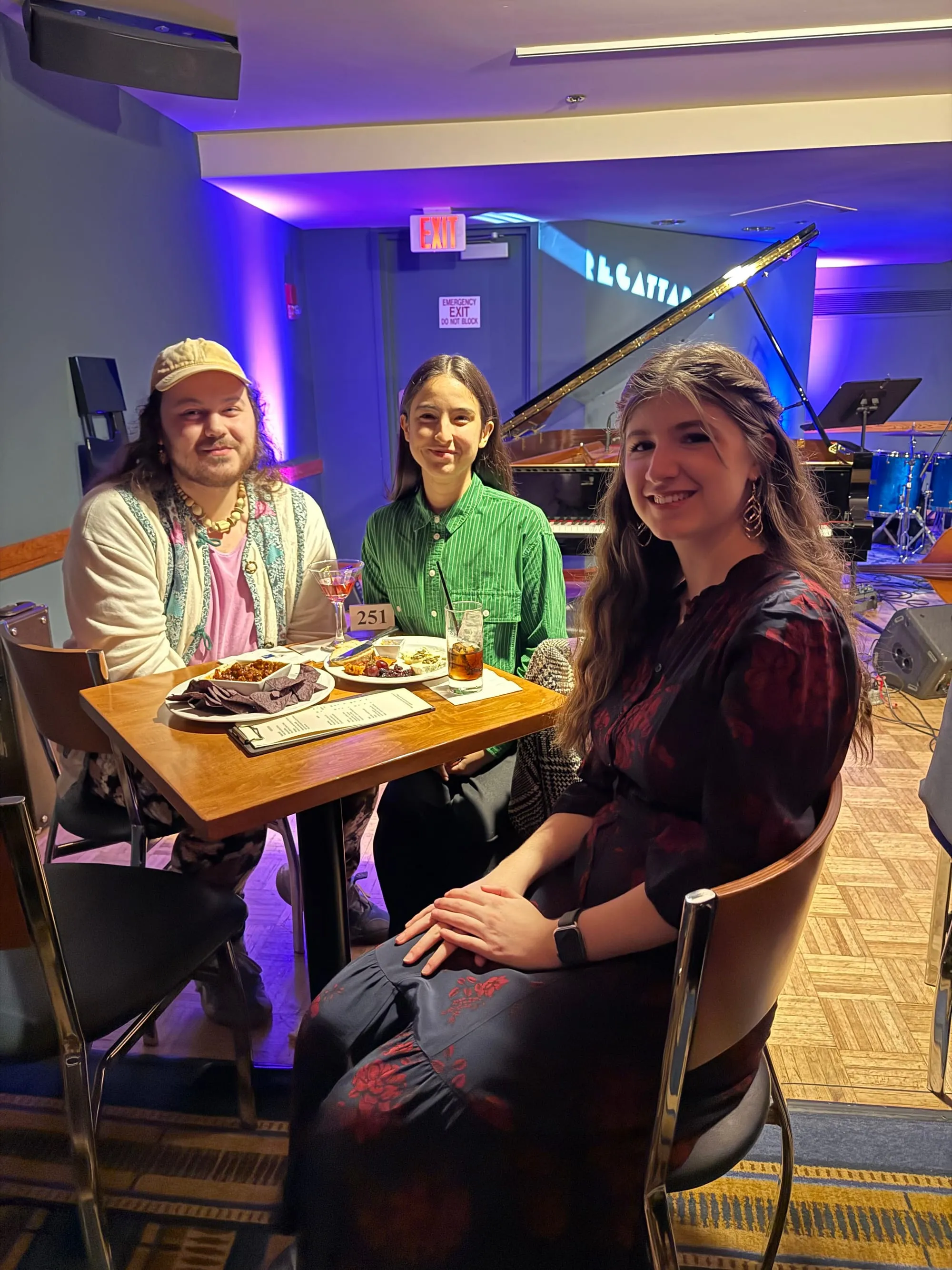
I had the chance to interview Fall Raye and Simon Montalvo, friends and collaborators of Devon. Fall and Devon released an album, and I met Fall at the album’s release party. I met Simon (with whom Devon has an upcoming show) at the Regattabar.
Laurel: What kind of work have you guys done with Devon, and how did you meet her?
Fall: I met Devon at Berklee. We did the Jazz and Gender Justice program together, and just got to know each other over the years, and started playing a lot. I love Devon Gates so much. I'm the biggest fan! I ask her to play anything that she can of mine, and she will be there playing it, because she's so amazing. And we've seen her shows before at the Regattabar. We released an album together called Lamento with Raúl Molina playing drums.
L: So great. What do you play?
F: I play saxophone.
L: Cool! And what about you, Simon?
Simon: So I met Devon also at Berklee, but through Fall. Sometimes we'd be sitting in on rehearsals, and then eventually I started dancing—improvising for some of their rehearsals—and then Devon asked me to hop on some sets and work through some movements. And then we were in the Sounds of Liberation Collective that Devon had put together. So we were in that last year with her as well.
L: That's amazing. And what kind of dance do you do?
S: Mostly contemporary and improvisation.
L: Oh, awesome. I also was curious: Is there anything tonight that you guys want to hear from Devon in particular?
F: Well, I know that she loves writing for string players, and I know that she has a few string players on tonight, so I'm excited to hear that. I’m excited to hear some new music from her and maybe older music that’s reimagined for this group... But I'm just excited to hear her sing and play the bass!
L: It's a great combo.
S: The “Dave the Potter” song is one of my favorites, and I've danced to it before, but just being able to sit and hear it—I love it. I love the story. It's beautiful.
L: Thank you both!
Laurel Aronian ('29) is a staff writer for WHRB. She'll see you at Devon Gates’ next gig!